A self-employment visa for the Netherlands is formally the residence permit for self-employed persons (verblijfsvergunning voor zelfstandigen). The Immigration and Naturalisation Service (IND) grants it to nationals from outside the EU, the EEA and Switzerland who want to run their own business here, after the Netherlands Enterprise Agency (RVO) has advised on whether that business serves an essential Dutch interest. The permit is issued for a maximum of two years and allows self-employed work only.
The decisive question is therefore not whether you are a capable entrepreneur, but whether your file proves that the Netherlands gains something from your business. The RVO works with a points test that looks arithmetical but leaves real room for judgement, and it awards points only for claims you can substantiate. This article sets out who can apply, how the points test works, what the business plan has to prove, how the procedure runs and what you must arrange once you arrive.
What the residence permit for self-employed persons covers
The permit allows you to work in the Netherlands on a self-employed basis: as the owner of a business, as a freelancer or as an independent contractor. The residence document carries the endorsement that self-employed work is permitted and that no separate work permit is required. It does not entitle you to take up paid employment; for that, an employer would have to obtain a separate work permit or you would have to switch to another residence purpose.

Who decides, and for how long
The IND decides on the residence permit; the RVO, on behalf of the Ministry of Economic Affairs, advises on the economic interest of your business. In practice the RVO advice is decisive: a negative advice almost always leads to a refusal. The permit runs for a maximum of two years and can be extended as long as the business still meets the conditions. Self-employment counts as a non-temporary residence purpose, so years spent on this permit count towards a permanent residence permit after five years of continuous lawful residence, provided you also satisfy the civic integration and income conditions that apply then.
Who can apply, and who is exempt from the points test
You need a passport from a country outside the EU, the EEA and Switzerland that remains valid for the whole of your intended stay, and you must meet the general conditions that apply to every residence permit: no public order objections, a tuberculosis test where your nationality requires one, and an income from the business that keeps you off public funds. The Dutch immigration system first checks those baseline conditions and only then looks at the substance of your business.

Not everyone goes through the points test. Nationals of the United States rely on the Dutch-American Friendship Treaty and Japanese nationals on the Netherlands-Japan trade agreement; both routes require a minimum amount of capital invested in the business rather than a points score, and the IND publishes that amount. Turkish nationals are assessed under the standstill clause of the EEC-Turkey Association Agreement, which means the conditions that applied when that clause took effect are used instead of the current ones. Holders of EU long-term resident status in another member state also fall outside the points test. Everyone else is scored.
How the RVO points test works
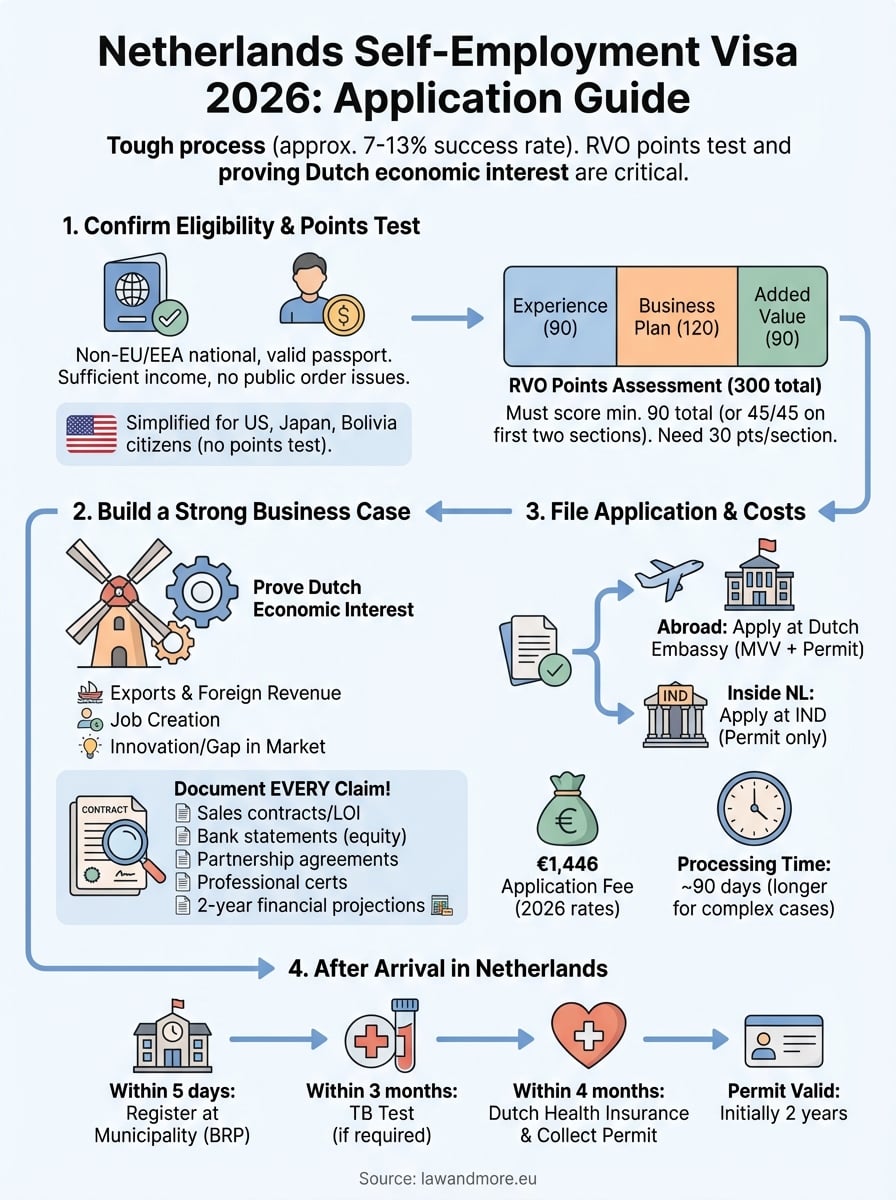
The RVO scores three areas: your personal experience, the quality of the business plan, and the added value of the business for the Netherlands. Your business is regarded as being of essential Dutch interest if you obtain at least thirty points in each of the three areas, or alternatively at least forty-five points for personal experience together with forty-five points for the business plan. The exact scoring tables, and the evidence the RVO accepts for each item, are published by the RVO and are updated from time to time, so work from the current version rather than from a summary.
The RVO awards points only for claims that are supported by documents; an unsupported statement scores nothing.
Independent professionals in a small number of fields, such as certain medical specialists and artists, are assessed on advice from the responsible ministry instead of through the points test. If you think you fall into that category, establish it before you build a file around the wrong test.
What your business plan has to prove
The business plan is the heart of the application. It has to show two things at once: that the business is financially viable, and that the Netherlands has an interest in it beyond your own income. A plan that reads as a personal career move, however sound commercially, tends to score badly on the third area of the test.
Showing a Dutch interest
Activities that bring foreign revenue into the Netherlands, create work for people already living here, introduce something the Dutch market lacks, or add innovation in your field are the ones that carry weight. Make the claim concrete and measurable rather than general: name the counterparties, the volumes and the timescale on which you expect them. An invitation or commission from a publicly funded Dutch cultural institution, or a grant from a recognised fund, is the kind of external confirmation the RVO values, and it belongs in the file in full.

Evidence for every claim
Each figure and each qualification in the plan needs a document behind it. Revenue projections are supported by signed contracts, letters of intent or memoranda of understanding; capital by bank statements in your own name; collaborations by a signed agreement; expertise by diplomas, certificates and references.
| Claim in the business plan | Evidence the RVO expects |
|---|---|
| Turnover in the first year | Signed contracts or detailed letters of intent from named clients |
| Own capital in the business | Bank statement showing the amount in an accessible account |
| Cooperation with a Dutch company | Signed cooperation agreement with company details and Chamber of Commerce number |
| Sector experience | Diplomas, professional certificates and references from former clients or employers |
Documents in a language other than Dutch, English, French or German must be translated by a sworn translator, and foreign official documents generally need to be legalised or carry an apostille. Arrange that early: it is the step that most often delays a file.
The income requirement and what the application costs
Your business must produce enough income to support you without recourse to public funds. The IND derives that norm from the statutory minimum wage and publishes it as a gross monthly profit figure; because the minimum wage is adjusted on 1 January and on 1 July, the norm changes twice a year. Check the amount on the IND website on the day you file, and have an accountant or bookkeeper draw up profit projections for the full period the permit is to cover, broken down by year and tied to the contracts in the file.
The application fee is set by the Minister of Asylum and Migration and published per application type on the IND website, where it is normally adjusted at the start of the calendar year. The IND has a statutory decision period of ninety days, which it may extend, and the RVO advice runs inside that period. Note that since 15 April 2025 there is no longer an administrative penalty payment for a late decision; if the deadline passes without a decision, the remedy is an appeal against failure to decide.
Where and how you file
Where you file depends on where you are. If you live abroad, you apply through the Dutch embassy or consulate in your country of residence or nationality, in most cases as a combined application for a provisional residence permit and the residence permit itself under the MVV and TEV procedure. The mission forwards the file to the IND, which asks the RVO for advice. You travel to the Netherlands only after the provisional residence permit has been issued.

If you are already in the Netherlands on another valid permit, for example a student permit or an orientation year permit, you apply to the IND directly to change your residence purpose and no provisional residence permit is needed. Whether your current permit lets you keep working while the change is pending depends on its endorsement, so check that before you wind down other work-related permissions.
What goes into the file
| Category | Documents |
|---|---|
| Identity | Valid passport and passport photographs meeting the Dutch requirements |
| Business | Chamber of Commerce registration and the business plan set up along the RVO scoring areas |
| Financial | Bank statements evidencing capital and profit projections drawn up by a bookkeeper |
| Substantiation | Contracts, letters of intent, cooperation agreements, diplomas and references |
An incomplete file is not refused outright: the IND sets a short period in which to supply what is missing. That period is genuinely short, so it is better to file complete than to file quickly.
What you arrange after arrival
Registration in the Personal Records Database (BRP) at your municipality follows within five days of arrival if you are staying longer than four months; the municipality issues the citizen service number (BSN) you need for banking, tax and healthcare. You collect the physical residence document at an IND desk on appointment. If your nationality requires a tuberculosis test, you undergo it at the municipal health service (GGD) within three months, and you take out Dutch health insurance within four months of the permit being granted.
From that point the obligations are ongoing rather than one-off. The business must keep meeting the conditions on which the permit was granted, changes such as a different legal form, a new activity or a lasting drop in profit are relevant to an extension, and the IND expects to be informed of a change of address. Keep the administration in a state where you could evidence the original claims again two years later, because that is exactly what an extension application asks for.
Why applications are refused
Refusals rarely turn on the entrepreneur being unsuitable. They turn on the file. The recurring causes are a plan that describes ambitions without evidence, projections that no bookkeeper has signed off, a Dutch interest asserted in general terms instead of demonstrated, capital that is shown in an account belonging to somebody else, and translations or legalisations that arrive after the deadline. A second common cause is a mismatch between the residence purpose and reality: an application presented as self-employment that on inspection is a single client relationship with the characteristics of employment.
If the IND refuses, you can lodge a notice of objection within four weeks of the decision under the Aliens Act. That period is strict. An objection is worthwhile when the refusal rests on a misreading of the file or on evidence the RVO overlooked; where the plan itself is the weak point, a fresh and better substantiated application is often the faster route. In either case, ask for the RVO advice itself, because it sets out point by point where the score fell short.
How Law and More can help
Our immigration lawyers assess whether the points test, a treaty route or another residence purpose gives you the best prospects, test the business plan against the RVO scoring areas before it is filed, and put the supporting evidence in order. We also act in objection and appeal proceedings against a refusal or against a late decision. If you are considering an application, or have just received a negative decision, contact us to discuss what your file needs. Our wider immigration law practice covers the permits your family members and any staff will need alongside your own.
Frequently asked questions
Who can apply for a self-employment visa in the Netherlands?
The self-employment (zelfstandige) residence permit is for entrepreneurs who want to run their own business in the Netherlands. Applicants must show their business serves an essential Dutch interest and pass the IND and RVO assessment, which uses a points-based test.
How does the points-based test for the Dutch self-employment visa work?
The IND relies on advice from the RVO, which scores your application across criteria such as personal experience, business plan, and added value to the Dutch economy. Although it looks objective, it involves considerable judgement, so a well-evidenced business case is essential.
What is the success rate for the Dutch self-employment visa?
Neither the IND nor the RVO publishes a fixed approval rate, and the figures circulating online are not official. What is clear is that the points test leaves room for judgement, so files with thin supporting evidence are regularly refused.
What documents do I need for a self-employment visa application?
You need extensive documentation supporting every claim, including a detailed business plan, proof you meet the income thresholds, evidence of a Dutch interest, and records of your qualifications and experience. Incomplete files are a common reason for refusal.
Can a lawyer help with a Dutch self-employment visa application?
Yes. Because the test involves judgement and refusals usually turn on gaps in the evidence, professional help in structuring your business case and documentation significantly improves your chances. A lawyer can guide you through the IND and RVO process.